How the discrete index works
OverlapIndex separates prototype construction from overlap scoring. The chosen backend builds prototypes owned by labels, and the estimator applies the same directional class-pair logic to those prototypes.
From samples to prototypes
For an offline backend, a separate KMeans, MiniBatchKMeans, or BallCover model is fit for every label. Their local prototypes are concatenated into one set of global prototype IDs while ownership is retained. A multi-label sample is copied once for every positive label during prototype fitting.
For an ARTMAP backend, supervised incremental learning creates and updates the label-owned prototypes directly.
The scoring layer is not tied to a single prototype geometry: centroid, landmark-ball, Fuzzy ART, and hypersphere representations all expose the same class-owned best-matching-unit interface. Geometry still matters to the measured value, so comparisons should keep the backend and its resolution fixed.
predict(X) returns these global prototype IDs. It is therefore useful for
inspecting the fitted representation, but it does not return predicted
class labels.
Directional pairwise scores
For a source label \(a\) and competitor \(b\), each source sample is compared only against prototypes owned by \(a\) or \(b\). The estimator finds the sample’s own best-matching prototype, then checks whether the strongest alternative belongs to \(b\). Let \(O_{a,b}\) be the number of these overlap events and \(N_{a,b}\) the number of evaluable source rows. The directional score is
The direction matters: \(I_{a,b}\) and \(I_{b,a}\) can differ because their source rows and denominators differ. On ordinary single-label data, \(N_{a,b}\) is the support of \(a\). On multi-label data, it contains only rows where \(a\) is present and \(b\) is absent.
In an incremental ARTMAP run these activation counts are updated as labeled samples arrive. Offline backends compute the same bookkeeping after fitting their class-owned prototypes to the supplied batch.
Per-label and global aggregation
The per-label score is its worst evaluable competitor:
The public index is the macro mean of \(I_a\) over evaluable labels not listed
in exclude_classes. Every included label has equal influence. The
weighted_index property instead weights each \(I_a\) by that label’s positive
sample support in cluster_cardinality.
This hierarchy is reflected directly in fitted attributes:
Level |
Attribute |
Key |
|---|---|---|
Directional class pair |
|
|
Source label |
|
|
Global macro |
|
scalar |
Global support-weighted |
|
scalar property |
Interpreting values
1.0: no overlap event was observed at the chosen prototype resolution.Between
0.0and1.0: partial overlap or separation.0.0: every evaluable source row produced an overlap event, indicating complete overlap at the chosen prototype resolution.
These are interpretation anchors, not universal quality thresholds. The score depends on the feature representation, scaling, backend geometry, prototype count, and evaluated data. It is meaningful to compare runs only when those choices are controlled.
Discrete visual examples
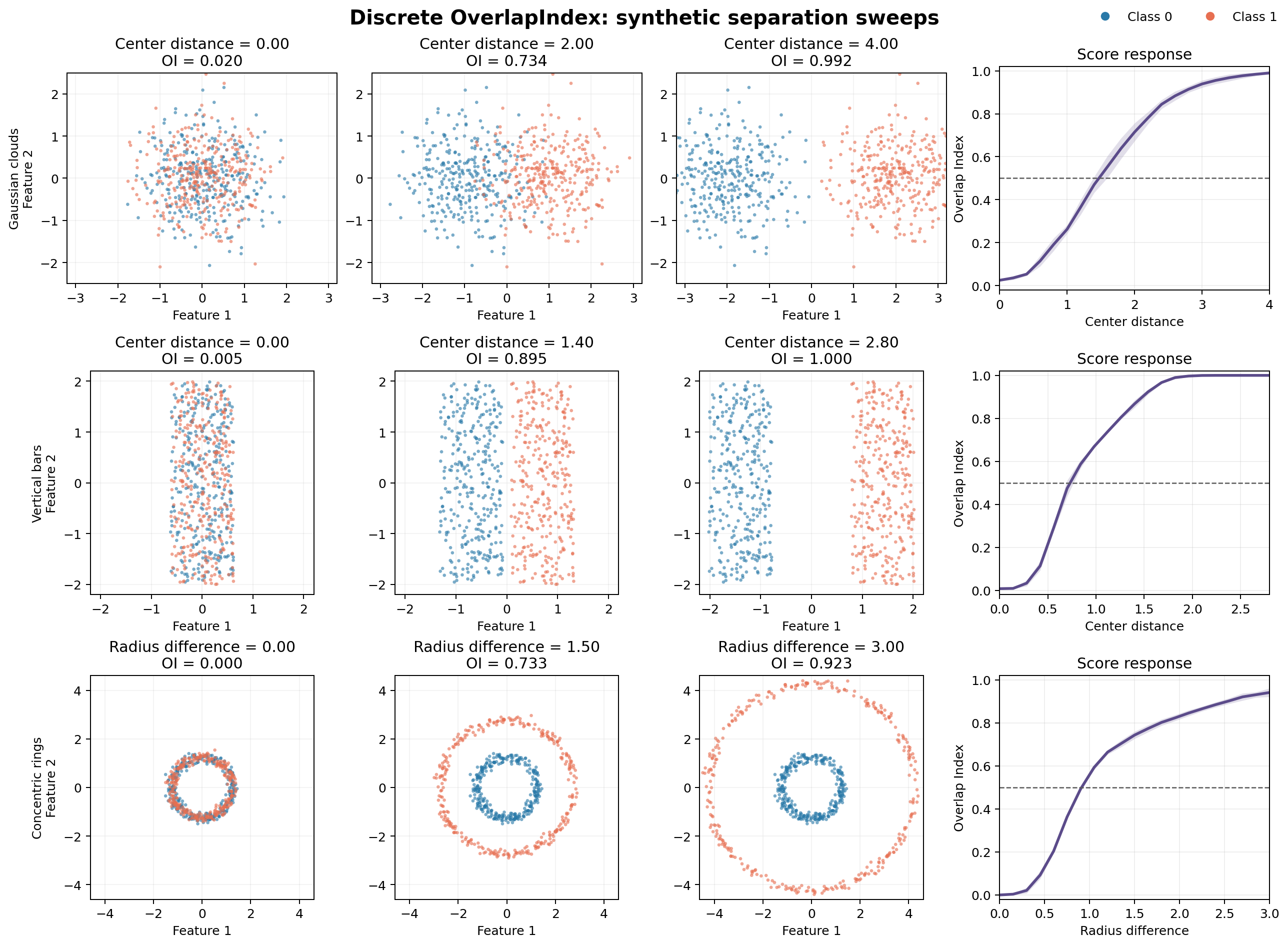
The figure below contains the three discrete examples from the project README, each swept from fully interleaved to well separated:
Gaussian clouds vary the distance between two class centers.
Vertical bars vary horizontal separation while retaining elongated class geometry.
Concentric rings vary the difference between class radii, demonstrating behavior on non-convex supports that cannot be summarized by center distance alone.
Each row shows representative low-, intermediate-, and high-separation datasets followed by the complete score-response curve. Curves are means over repeated deterministic draws; the shaded band is one standard deviation.
Regenerate all three examples from the repository root with:
poetry run python examples/visualize_discrete_overlap_sweeps.py
The script writes img/discrete_overlap_sweeps.png by default and accepts
--output PATH to select another destination.
Prototype resolution
Top-two scoring is best resolved with at least two prototypes per label. When
a label owns fewer than two, fitting continues but emits a warning and records
the label in under_prototyped_labels_. This often occurs when kmeans_k=1, a
class contains only one sample, or a BallCover configuration produces a single
ball.
More prototypes are not automatically better. They can represent curved or multimodal support more faithfully, but also increase runtime and change the scale at which overlap is measured. Tune resolution on a representative dataset, then hold it fixed for comparisons.
Excluded labels
exclude_classes affects only the final macro and weighted aggregations. An
excluded label still owns prototypes, acts as a competitor, and appears in
singleton_index, pairwise_index, and support bookkeeping. This is useful
for a background or unknown label that should influence foreground overlap but
should not receive equal weight in the global summary.